Staged SSI — gravity first, then the absorbing flip
The plane-wave SSI example was a pure-wave skeleton: no gravity, just a pulse from the base. A real soil model runs gravity first — the soil settles under its own weight while the boundary holds it, the in-situ state is frozen, and only then does the dynamic shaking begin on top of that equilibrated state. This example adds that gravity stage, which is the canonical soil–structure-interaction sequence:
- Gravity stage. The absorbing skin is still in its hold state
(a penalty support), so it pins the box while self-weight settles the
column.
loadConstfreezes the result att = 0. - Flip + transient.
s.activate_absorbingswitches the skin to absorbing, baking in the gravity displacement as its reference, and the base wavelet shakes the equilibrated column.
The interesting design question this example answers is how to apply self-weight to a continuum, because OpenSees gives you two routes that behave very differently.
Two ways to load gravity — and why this example picks one
A continuum element (stdBrick, FourNodeQuad, …) takes an optional
body_force triple. It is tempting to use it for gravity:
But body_force is applied every step, unconditionally — it is not
a load pattern. Verified against the OpenSees source
(Brick.cpp:1268-1274, FourNodeQuad.cpp:890-906) and a live single-
element probe: the element integrates the constructor b into its
resisting force whether or not any eleLoad exists. That means
body_force gravity:
- cannot be ramped in over a few steps,
- cannot be scaled by a time series,
- is not frozen by
loadConst— it is on from the first step of the first stage, through the transient, forever.
For a staged model that is the wrong tool: you want gravity to ramp in during the gravity stage, hold, and then sit quietly (frozen) under the dynamics. So this example uses the pattern-controlled nodal route instead — author the weight at the geometry and import it into the gravity stage's pattern:
with g.loads.case("dead"):
    g.loads.gravity(res.soil_pg, density=rho, g=(0.0, 0.0, -9.81))
# ... later, in the bridge:
with ops.stage(name="gravity") as s:
    with s.pattern(series=grav_ts) as p:
        p.from_model("dead")        # ← pattern-controlled, loadConst-freezable
g.loads.gravity lumps each element's weight ρ·V·g onto its nodes.
For the structured hex boxes used here that tributary split is exactly
the consistent (Gauss-integrated) body-force vector — so it is not an
approximation, it is the same load body_force would assemble, just
under your control.
Don't do both
If you put body_force= on the brick and import a gravity case
onto the same nodes, the region carries its self-weight twice.
The bridge catches the collision and raises
WarnBodyForceDoubleCount at build time. Pick one route.
The whole model
import os, sys
import numpy as np
from apeGmsh import apeGmsh
from apeGmsh.opensees import apeSees
from apeGmsh.opensees.material.nd import ElasticIsotropic
from apeGmsh.opensees.time_series.time_series import Ricker

# --- Problem data (consistent SI: m, N, Pa, kg, s) ---
rho, nu, Vs = 2000.0, 0.3, 200.0     # density, Poisson, target shear-wave speed
G = rho * Vs**2                      # 8.0e7 Pa
E = 2.0 * G * (1.0 + nu)             # 2.08e8 Pa
H, g_acc = 40.0, 9.81                # column depth [m], gravity [m/s^2]
traveltime = H / Vs                  # 0.20 s

f_n, t_center, dt, t_total = 4.0, 0.15, 0.002, 1.0
n_steps = round(t_total / dt)

surf, base_disp = "surf_vel.out", "base_disp.out"

# --- 1. Geometry: soil box + absorbing skin; author the gravity case ---
with apeGmsh(model_name="grav_ssi") as g:
    res = g.parts.add_plane_wave_box(x=(20.0, 2), y=(20.0, 2), z=(H, 16))
    with g.loads.case("dead"):
        g.loads.gravity(res.soil_pg, density=rho, g=(0.0, 0.0, -g_acc))
    g.mesh.generation.generate(dim=3)
    fem = g.mesh.queries.get_fem_data()

# --- 2. Bridge: soil brick (NO body_force) + absorbing skin ---
ops = apeSees(fem)
ops.model(ndm=3, ndf=3)

soil = ops.register(ElasticIsotropic(E=E, nu=nu, rho=rho))
base = ops.register(Ricker(f_n=f_n, t_total=t_total, dt=dt,
                           t_center=t_center, kind="velocity", factor=0.01))
grav_ts = ops.register(ops.timeSeries.Linear())

ops.element.stdBrick(pg=res.soil_pg, material=soil)
ops.element.absorbing_boundary(skin=res, material=soil,
                               base_series=base, base_dirs=("x",))

# --- 3a. Gravity stage: the skin HOLDS while self-weight settles ---
with ops.stage(name="gravity") as s:
    with s.pattern(series=grav_ts) as p:
        p.from_model("dead")                      # ramp gravity in
    s.recorder(ops.recorder.Node(
        file=base_disp, response="disp",
        pg=res.free_surface_pg, dofs=(3,), time_format="dt",
    ))
    s.analysis(
        test=ops.test.NormDispIncr(tol=1e-8, max_iter=30),
        algorithm=ops.algorithm.Newton(),
        integrator=ops.integrator.LoadControl(dlam=0.1),
        constraints=ops.constraints.Transformation(),
        numberer=ops.numberer.RCM(),
        system=ops.system.UmfPack(),
        analysis=ops.analysis.Static(),
    )
    s.run(n_increments=10)            # gravity -> full; loadConst freezes it

# --- 3b. Dynamic stage: FLIP the skin, then shake from the base ---
with ops.stage(name="dynamic") as s:
    s.activate_absorbing(pg=res.skin_all_pg)      # hold -> absorbing
    s.recorder(ops.recorder.Node(
        file=surf, response="vel",
        pg=res.free_surface_pg, dofs=(1,), time_format="dt",
    ))
    s.analysis(
        test=ops.test.NormDispIncr(tol=1e-8, max_iter=20),
        algorithm=ops.algorithm.Newton(),
        integrator=ops.integrator.Newmark(gamma=0.5, beta=0.25),
        constraints=ops.constraints.Transformation(),
        numberer=ops.numberer.RCM(),
        system=ops.system.UmfPack(),
        analysis=ops.analysis.Transient(),
    )
    s.run(n_increments=n_steps, dt=dt)

ops.py("grav_ssi.py", run=True)        # emit the openseespy deck and run it

# --- 4. Read both outputs, run the checks ---
settle = np.loadtxt(base_disp)[-1, 1:].mean()          # vertical, after gravity

data = np.loadtxt(surf)
t = data[:, 0]
v = data[:, 1:].mean(axis=1)
absv = np.abs(v)
peak = absv.max()
t_arr = t[int(np.argmax(absv > 0.05 * peak))]
late = float(absv[t >= 0.7].max())

print(f"surface settlement (gravity) = {settle:.3e} m")
print(f"H/Vs            = {traveltime:.3f} s")
print(f"first arrival   = {t_arr:.3f} s")
print(f"late max (>0.7) = {late:.3e} m/s   ({late/peak:.2%} of peak)")
Run it. You should see:
surface settlement (gravity) = -5.606e-02 m
H/Vs            = 0.200 s
first arrival   = 0.198 s
late max (>0.7) = 6.488e-06 m/s   (0.93% of peak)
Three things land:
- Gravity settled the column. The free surface drops 5.6 cm under self-weight, with the absorbing skin holding the boundary — the in-situ state a real analysis needs.
- The wave still arrives at $H/V_s$. First motion shows up at 0.198 s after the flip, matching the shear traveltime — the gravity stage did not disturb the wave physics.
- It still radiates. Late-window surface motion holds at 0.93 % of
peak, identical to the pure-wave run:
loadConstfroze gravity as a static offset and the linear dynamic response rides on top, undisturbed.
Why the skin has to hold during gravity
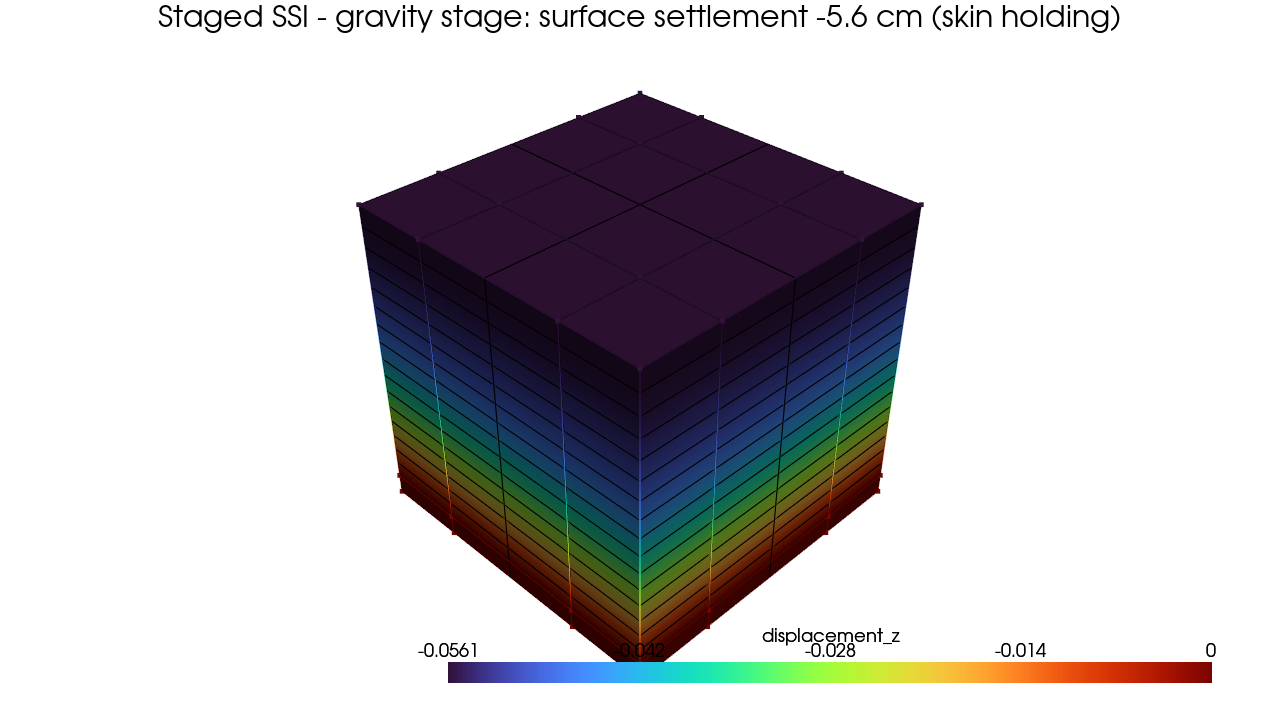
This is the whole reason the absorbing layer is extra material outside
an intact soil box (ADR 0054). In its hold state the
absorbing element behaves as a fixed support with zero gravity mass —
so it pins the truncation boundary while the interior settles, without
itself contributing spurious weight. At the flip, s.activate_absorbing
bakes the current displacement and the frozen stage-0 reactions into the
element's reference state, then switches on the dashpots. Settle, freeze,
flip, shake — in that order.
Going further — a true geostatic stress
This example reaches its in-situ state by settling an elastic column.
For a nonlinear soil you usually want to install the geostatic stress
directly rather than compress your way into it, which is what
s.initial_stress(...) does (parameter-ramped $\sigma$, ADR 0028) — add
it to the gravity stage alongside the from_model weight. And a structure
on the surface ties or embeds against res.free_surface_pg, driven by the
radiated motion. The skeleton here is the foundation those build on.
Next: Moment-tensor seismic source.